
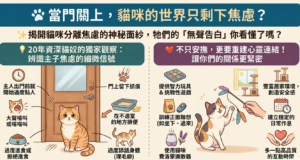
當門關上,牠的世界只剩下焦慮:20年老僕解密貓咪分離焦慮的無聲告白與心靈連結重建新哲學
When the Door Closes, Only Anxiety Remains in Their World: A 20-Year Cat Servant Deciphers the Silent Confession of Feline Separation Anxiety and a New Philosophy for Rebuilding Emotional Connection
清晨,窗外鳥鳴初歇,室內光線微醺。我輕輕翻身,枕邊的重量消失,取而代之的是一陣暖意。是牠,我的老貓阿麥,總是在我醒來前幾分鐘,悄然跳上床,將溫熱的身體緊貼我的背脊。那輕柔的呼吸聲,彷彿在宣告:「早安,我的世界,我的全部。」我轉過身,牠那雙翠綠的眼睛,如兩汪深潭,滿載著信任與依戀,輕輕摩蹭我的臉頰,發出滿足的咕嚕聲。那一刻,我是牠宇宙的中心,牠是我的毛絨暖爐。但這種親密,有時也伴隨著一份沉重的掛念。我記得有那麼一段日子,每次當我準備出門,換上外出服,拿起鑰匙,阿麥總是會從床底、櫃子後探出頭來,那眼神,從最初的疑惑,漸漸轉為不安。接著,是輕柔的哀鳴,音調越來越高,最終演變成一聲聲刺耳的淒厲叫喚。我知道,那是牠的無聲控訴,控訴著我即將離開,留下牠獨自面對漫長的空寂。
一開始,我以為牠只是在撒嬌,在表達不捨。然而,從鄰居的抱怨,到回家後滿目瘡痍的客廳——沙發邊緣被扯得稀爛,垃圾桶被翻倒,甚至,偶爾會發現牠在貓砂盆外,留下那一灘灘濕潤的痕跡——我才意識到,這不是撒嬌,而是一種深切的痛苦。牠的每一次破壞,每一次哀嚎,都是在對我呼喊:「別走!我好怕!」
我心如刀絞,每一次關上門,都像是在親手撕裂牠那顆敏感的心。那種無力感,讓我徹夜難眠。我開始研究,開始觀察,試圖從牠細微的動作、眼神中,讀懂牠的焦慮。我明白,牠的世界如此簡單,只有我。而當我缺席時,牠的宇宙便塌陷了。這二十年來,我學會的,不只是如何照顧牠的飲食起居,更重要的是,如何去理解並撫慰牠那顆因愛而生的焦慮之心。這篇文章,是獻給所有為貓咪分離焦慮所困擾的毛爸媽,也是獻給那些無言承受著孤獨與恐懼的貓咪們。讓我們一同探究這份深沉的情感,重建那份斷裂的心靈連結,讓牠們的等待,不再是煎熬。
Early morning, the birds outside have just hushed, and the room is bathed in soft light. I gently turn over, and the weight on my pillow disappears, replaced by a warmth. It’s him, my old cat Amaï, who always quietly jumps onto the bed a few minutes before I wake up, pressing his warm body against my back. His soft purring seems to declare, “Good morning, my world, my everything.” I turn around, and his emerald eyes, like two deep pools, brimming with trust and affection, gently rub against my cheek, emitting a contented purr. In that moment, I am the center of his universe, and he is my fluffy warm blanket.
But this intimacy sometimes comes with a heavy concern. I remember a period when, every time I prepared to leave, putting on my outdoor clothes, picking up my keys, Amaï would always peek out from under the bed or behind the cabinet. His gaze, from initial confusion, gradually turned into unease. Then came a soft meow, its pitch rising, eventually escalating into a series of sharp, desperate cries. I knew it was his silent protest, accusing me of leaving him alone to face the long emptiness.
At first, I thought he was just being clingy, expressing reluctance to part. However, from neighbor complaints to the wreckage I found in the living room upon returning home—shredded sofa edges, overturned trash cans, and occasionally, discovering wet spots outside the litter box—I realized this wasn’t just affection; it was a profound pain. Every destructive act, every mournful cry, was his way of shouting to me: “Don’t go! I’m so scared!”
My heart ached. Every time I closed the door, it felt like I was tearing his sensitive heart apart with my own hands. That feeling of helplessness kept me awake at night. I began to research, to observe, trying to read his anxiety from his subtle movements and eyes. I understood that his world was so simple, consisting only of me. And when I was absent, his universe collapsed. In these twenty years, I’ve learned not only how to care for his food and shelter but, more importantly, how to understand and soothe his anxious heart, born of love. This article is dedicated to all cat parents struggling with feline separation anxiety, and to the cats silently enduring loneliness and fear. Let us explore this deep emotion together, rebuild that broken emotional connection, and ensure their waiting is no longer an ordeal.
【深度行為解析】
生理層面,焦慮情緒會導致貓咪體內皮質醇(Cortisol)等壓力荷爾蒙飆升,長期下來可能影響免疫系統,甚至誘發其他生理疾病,如特發性膀胱炎(Feline Idiopathic Cystitis, FIC)或消化道問題。過度舔毛(Over-grooming)導致的皮膚炎,也是壓力反應的常見表徵。異常排泄,如在貓砂盆外排泄,除了生理疾病排除後,多半是因極度不安而尋求熟悉的氣味以作安撫,或單純是壓力導致的行為失控。研究指出,約有 13-17% 的家貓在某些生命階段會出現不同程度的分離焦慮症狀,且與早年缺乏安全感、過早斷奶、或曾經被遺棄等經歷有關。這份焦慮,是牠們用最原始的本能,向我們發出的無聲求救。理解這一點,是解決問題的第一步。
Cats, often perceived as independent and mysterious creatures, actually harbor a deep reliance on community and territory within their primal genes. They don’t live in packs like dogs but exist in more loosely structured groups, with a strong sense of territory. When we bring them from the wild into our homes, making them “domestic cats,” their “community” often condenses into our human family members. In this environment, specific human members, especially the primary caregiver, become their sole “anchor” for security, food, and emotional solace.
Separation Anxiety in cats manifests differently from dogs, but its core stems from extreme stress caused by the departure of the primary caregiver. This behavior is not malicious retaliation but originates from a deep “Separation Stress Response.” From a behavioral perspective, cats link human departure cues, such as putting on a coat, picking up keys, or the sound of the door opening, with impending loneliness, forming “Anticipatory Anxiety.” Their destructive behaviors, like scratching furniture or overturning trash cans, are often attempts to seek sensory stimulation or self-soothe through the familiar scent on objects or the adrenaline produced by the behavior itself. For instance, tearing up clothes with the owner’s scent is actually a chaotic form of “Attachment Behavior.”
Physiologically, anxiety leads to a surge in stress hormones like Cortisol in cats, which can, over time, affect their immune system and even trigger other physical ailments such as Feline Idiopathic Cystitis (FIC) or digestive problems. Over-grooming leading to dermatitis is also a common manifestation of a stress response. Abnormal elimination, such as urinating outside the litter box, after ruling out physiological issues, is often due to extreme unease as they seek familiar scents for comfort, or simply behavioral control loss due to stress. Studies suggest that approximately 13-17% of domestic cats will experience varying degrees of separation anxiety symptoms at some point in their lives, often linked to early life insecurity, premature weaning, or a history of abandonment. This anxiety is their silent plea to us, expressed through their most primal instincts. Understanding this is the first step to resolving the problem.
【老僕實戰心法】
* **脫敏訓練**:將你出門前的「信號」與實際出門脫鉤。例如,每天隨機穿上外套、拿起鑰匙,但不要真的出門;或走到門口,但只停留幾秒鐘就回來。重複多次,直到這些動作不再引起貓咪的明顯反應。
* **反制約訓練**:在進行上述信號動作的同時,給予貓咪牠最愛的零食或玩具。讓牠將這些信號與愉快的體驗連結起來。
**第二步:循序漸進的獨處訓練 (Gradual Departure)**
* **短暫離開**:從離開房間幾秒鐘開始,如果貓咪沒有表現出焦慮,立刻回來獎勵。逐步增加離開的時間,從房間到家門口,再到屋外。
* **創造「獨處儀式」**:每次離開前,給予牠一個填充了零食的益智玩具,或播放輕柔的古典樂/專為貓咪設計的音樂。讓牠將你的離開與有趣的、安靜的活動連結起來。
* **錄影觀察**:使用寵物監視器觀察你離開時貓咪的真實反應,這能幫助你判斷訓練進度,並找出焦慮的觸發點。
**第三步:環境改造與心靈安撫 (Environmental Enrichment & Emotional Support)**
* **垂直空間與藏身處**:提供足夠的貓跳台、貓樹、窗邊棲息地,讓貓咪有高處俯瞰和安全的藏身之處。
* **豐富的互動玩具**:確保牠在獨處時有足夠的益智玩具、貓抓板、逗貓棒等,最好是能讓牠「自娛自樂」的類型。
* **費洛蒙產品**:Feliway 等貓咪費洛蒙擴散器能模擬貓咪面部費洛蒙,有助於創造安全、平靜的環境。
* **不要誇大離別與重逢**:出門時,輕描淡寫地離開;回家時,先忽略貓咪幾分鐘,等牠冷靜下來再溫柔互動,避免強化牠對你離開和回來的過度反應。
**第四步:諮詢專業 (Professional Help)**
如果焦慮行為嚴重或沒有改善,請務必尋求獸醫或專業動物行為學家的幫助。他們可能建議藥物輔助治療,或提供更客製化的行為修正方案。
When dealing with feline separation anxiety, our goal is to rebuild their sense of security and gradually establish positive associations with being alone. This requires patience, observation, and systematic intervention.
**Step One: Alleviating Anticipatory Anxiety (Desensitization & Counter-conditioning)**
* **Desensitization Training**: Decouple your “departure signals” from actual departure. For example, randomly put on your coat, pick up your keys daily, but don’t actually leave; or walk to the door but only stay for a few seconds before returning. Repeat this until these actions no longer elicit a significant reaction from your cat.
* **Counter-conditioning Training**: While performing the signal actions mentioned above, give your cat their favorite treats or toys. Help them associate these signals with pleasant experiences.
**Step Two: Gradual Solitude Training (Gradual Departure)**
* **Brief Departures**: Start by leaving the room for a few seconds. If your cat shows no signs of anxiety, return immediately and reward them. Gradually increase the time you are away, from leaving the room to stepping out the front door, and then outside the house.
* **Create a “Solitude Ritual”**: Before each departure, provide your cat with a treat-filled puzzle toy or play soft classical music/music specifically designed for cats. Help them associate your departure with fun, calming activities.
* **Video Observation**: Use a pet camera to observe your cat’s actual reactions when you leave. This can help you gauge training progress and identify anxiety triggers.
**Step Three: Environmental Modification and Emotional Soothing (Environmental Enrichment & Emotional Support)**
* **Vertical Space and Hiding Spots**: Provide enough cat trees, cat condos, and window perches so your cat has elevated vantage points and secure hiding places.
* **Rich Interactive Toys**: Ensure they have plenty of puzzle toys, scratchers, wand toys, etc., especially types that allow them to “entertain themselves” when alone.
* **Pheromone Products**: Feliway and similar cat pheromone diffusers mimic natural feline facial pheromones, helping to create a safe, calm environment.
* **Don’t Exaggerate Goodbyes and Hellos**: When leaving, depart casually. When returning home, ignore your cat for a few minutes until they calm down before gently interacting, avoiding reinforcing their overreaction to your coming and going.
**Step Four: Seek Professional Help (Professional Help)**
If anxiety behaviors are severe or do not improve, it is crucial to seek help from a veterinarian or a certified animal behaviorist. They may suggest medication as an adjunct to therapy or provide a more customized behavior modification plan.
【智商稅警示區】
1. **高質量益智玩具 (Puzzle Feeders)**:這類玩具讓貓咪在進食過程中需要動腦筋,能有效分散牠們對主人離開的注意力,並滿足牠們的狩獵本能。推薦:[AFFILIATE_LINK] KONG Wobbler 或 Trixie Fun Board 等品牌,款式多樣,可依貓咪程度選擇。
2. **寵物智能攝影機 (Pet Camera with Two-Way Audio)**:這不僅能讓你即時觀察貓咪狀態,許多產品還具備雙向語音功能,讓你能在遠端安撫牠,或投餵零食。這是了解和應對分離焦慮的有效工具,也是性價比極高的投資。推薦:[AFFILIATE_LINK] Furbo 狗狗攝影機 (部分功能也適用貓咪) 或 Petcube Bites 2 Lite。
記住,任何產品都只是輔助,最重要的是你對貓咪的理解、耐心與正確的行為訓練。
The market is flooded with products claiming to “instantly solve separation anxiety,” many of which are unnecessary money traps. For example, expensive “calming devices” that claim to emit “special frequency” sounds, or “emotional calming sprays” with unknown ingredients and exaggerated effects. Most of these products lack scientific validation and only address symptoms, failing to solve the cat’s psychological problems at their root.
What truly helps cats with separation anxiety is building their sense of security and autonomy. Instead of spending a lot of money on ineffective products, invest in these two truly valuable alternatives:
1. **High-Quality Puzzle Feeders**: These toys require cats to use their brains during mealtime, effectively diverting their attention from the owner’s absence and satisfying their hunting instincts. Recommended: [AFFILIATE_LINK] KONG Wobbler or Trixie Fun Board and similar brands, with various styles to choose from based on your cat’s skill level.
2. **Pet Smart Camera with Two-Way Audio**: This not only allows you to observe your cat’s status in real-time but many products also feature two-way audio, enabling you to soothe them remotely or dispense treats. This is an effective tool for understanding and addressing separation anxiety, and a highly cost-effective investment. Recommended: [AFFILIATE_LINK] Furbo Dog Camera (some functions also suitable for cats) or Petcube Bites 2 Lite.
Remember, any product is merely an aid; what matters most is your understanding, patience, and correct behavioral training for your cat.