
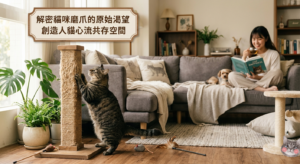
繁體中文:當爪痕訴說著原始的渴望:20年老僕解密貓咪磨爪的無聲語言與心流共存空間新哲學
English:When Claw Marks Whisper Primal Desires: A 20-Year Cat Servant Deciphers the Silent Language of Feline Scratching and the New Philosophy of FlowState Coexistence Spaces
繁體中文:
清晨,微亮的陽光透過窗紗,溫柔地灑落在客廳那張老舊的米色沙發上。我半夢半醒間,聽見熟悉的、帶著節奏感的「嘶啦、嘶啦」聲。不用睜眼,我也知道是我的老搭檔,那隻橘白相間、名叫「小橘」的貓咪,正在執行牠每日的「晨間儀式」——磨爪。那聲音時而輕柔如羽,時而響亮如雷,每一下都像是直接刻在我的心尖上。20年的光陰,我從一個對貓咪世界一無所知的青澀新手,變成了如今對牠們的每一個眼神、每一次呼吸都瞭若指掌的資深貓奴。這沙發,早已佈滿了小橘愛的「印記」,有些深有些淺,像極了我們共同走過的歲月痕跡。許多初次養貓的朋友,大概都經歷過那種從滿心期待,到看見家具被「改造」後的驚愕與無奈。那種心情,我太懂了。剛開始,我也曾氣急敗壞地想阻止牠,甚至買過一些「奇形怪狀」的防抓貼紙,結果呢?牠總能巧妙地找到縫隙,或者乾脆換個目標,將我剛買的藤編椅納入牠的「創作範圍」。那時,我看著那些被撕裂的纖維,心裡既疼惜家具,又困惑牠為何如此「冥頑不靈」。
直到有一天,我發現小橘在磨爪時,眼神是那麼地專注,肌肉線條是那麼地舒展,結束後還會滿足地伸個懶腰,彷彿完成了一項偉大的藝術創作。那不是破壞,那是牠的「表達」,是牠生命力最原始的展現。我開始意識到,阻止貓咪磨爪,就像要牠們停止呼吸一樣不切實際。我們的挑戰,從來不是「如何阻止牠磨爪」,而是「如何與牠的原始本能和平共處,並引導牠在我們都接受的方式下,滿足這份天性」。這是一種深層的理解與愛的轉化,從此,我學會了透過牠的爪痕,閱讀牠內心的渴望。
英文:
Early morning, soft sunlight filtered through the window screen, gently falling on the old beige sofa in the living room. Half-asleep, I heard the familiar, rhythmic “shhh-rip, shhh-rip” sound. Without opening my eyes, I knew it was my old companion, an orange and white cat named “Xiao Ju” (Little Orange), performing her daily “morning ritual”—scratching her claws. The sound was sometimes as soft as a feather, sometimes as loud as thunder, each stroke seemingly etched directly into my heart. Over 20 years, I’ve transformed from a novice utterly ignorant of the feline world into a seasoned cat servant who understands their every glance and every breath. This sofa is already covered with Xiao Ju’s “marks of love,” some deep, some shallow, much like the traces of the years we’ve spent together.
Many first-time cat owners have likely experienced that transition from eager anticipation to shock and helplessness upon seeing their furniture “renovated.” I understand that feeling perfectly. In the beginning, I too was frustrated and tried to stop her, even buying some “oddly shaped” anti-scratch stickers. The result? She always managed to find a gap or simply switch targets, incorporating my newly bought rattan chair into her “creative scope.” At that time, watching the torn fibers, I felt both pity for the furniture and confusion as to why she was so “stubborn.”
Then, one day, I noticed that when Xiao Ju scratched, her gaze was so focused, her muscles so stretched, and afterward, she would stretch contentedly, as if she had completed a grand work of art. That wasn’t destruction; it was her “expression,” the most primal display of her vitality. I began to realize that stopping a cat from scratching is as impractical as asking them to stop breathing. Our challenge has never been “how to stop them from scratching,” but “how to peacefully coexist with their primal instincts and guide them to fulfill this nature in a way we both accept.” This was a profound understanding and a transformation of love. From then on, I learned to read her inner desires through her claw marks.
【深度行為解析】
貓咪磨爪,絕非單純的破壞行為,它深植於貓科動物的原始基因,是生理與心理雙重需求的綜合體。從行為學角度來看,磨爪具有多重功能,每一道爪痕背後都藏著貓咪的「無聲語言」。首先,也是最直觀的生理需求,是爪子的維護。貓咪的爪子是伸縮自如的,最外層會定期老化並剝落。透過磨爪,牠們能有效地去除死去的角質層,保持爪子鋒利,如同我們修剪指甲一般。一雙健康且鋒利的爪子,對於貓咪的攀爬、狩獵和自我防禦至關重要。當你觀察貓咪磨爪時,會發現牠們會用力地將爪子插入物體,然後向下拉扯,這不僅能剝落舊的爪鞘,也能鍛鍊牠們前肢的伸肌和屈肌,維持肌肉的彈性與力量。
其次,磨爪是貓咪重要的領地標記行為。貓咪的肉墊上分佈著費洛蒙腺體(Pheromone Glands)。當牠們磨爪時,這些腺體會分泌出帶有貓咪獨特氣味的費洛蒙,附著在磨爪的表面。這就像牠們在說:「這是我的地盤!」這種化學標記比視覺標記更為隱蔽,卻更能有效地傳達訊息給其他貓咪,甚至對自己也有安撫作用,強化牠們對環境的歸屬感和安全感。因此,貓咪特別喜歡在顯眼的地方磨爪,例如門口、窗邊,這些都是牠們認為重要的「戰略要地」。
再者,磨爪是一種有效的伸展運動和壓力釋放機制。想像一下,剛睡醒的你是不是也喜歡伸個大大的懶腰?貓咪也是一樣。磨爪的動作涉及身體的大幅度伸展,尤其是脊椎和肩胛骨周圍的肌肉,這能幫助牠們舒展筋骨,提高身體的靈活性。而當貓咪感到焦慮、緊張或無聊時,磨爪也能成為一種自我安撫的方式,類似人類焦躁時會搓手或踱步。透過這種重複性的動作,牠們能有效地排解內心的壓力。
最後,磨爪也與牠們的狩獵本能息息相關。在野外,貓咪需要不斷磨礪爪子,才能在捕獵時精準地抓住獵物。即使家貓不再需要為食物奮鬥,這種古老的本能依然深植於DNA中。磨爪的行為讓牠們能保持這種準備狀態,滿足內心的原始衝動。這就是為什麼,一個不被允許磨爪的貓咪,其心理壓力會遠大於一個擁有適當磨爪環境的貓咪。理解這些深層原因,是我們與貓咪建立和諧共存的第一步。
英文:
Feline scratching is far from a mere destructive act; it is deeply rooted in the primal genes of felines, a complex blend of physiological and psychological needs. From a behavioral perspective, scratching serves multiple functions, with each claw mark concealing a cat’s “silent language.”
First, and most directly, there’s the physiological need for claw maintenance. A cat’s claws are retractable, and their outermost layers regularly age and shed. Through scratching, they effectively remove these dead keratin layers, keeping their claws sharp, much like how we trim our nails. Healthy, sharp claws are crucial for a cat’s climbing, hunting, and self-defense. When you observe a cat scratching, you’ll notice they forcefully embed their claws into an object and then pull downwards. This not only sheds old claw sheaths but also exercises the extensor and flexor muscles of their forelimbs, maintaining muscle elasticity and strength.
Second, scratching is a vital territorial marking behavior. Pheromone glands are distributed on a cat’s paw pads. When they scratch, these glands secrete pheromones with the cat’s unique scent, which adhere to the scratched surface. This is like them saying, “This is my territory!” This chemical marking is more subtle than visual marking but more effectively communicates messages to other cats, and even has a calming effect on themselves, reinforcing their sense of belonging and security in their environment. This is why cats particularly enjoy scratching in conspicuous places, such as doorways or by windows, which they consider important “strategic locations.”
Furthermore, scratching is an effective stretching exercise and a stress-release mechanism. Imagine, after waking up, don’t you also enjoy a good stretch? Cats are the same. The act of scratching involves extensive body stretching, especially the muscles around the spine and shoulder blades, which helps them limber up and improve body flexibility. And when cats feel anxious, stressed, or bored, scratching can also serve as a self-soothing method, similar to how humans might wring their hands or pace when agitated. Through this repetitive action, they can effectively alleviate internal pressure.
Finally, scratching is closely related to their hunting instincts. In the wild, cats need to constantly sharpen their claws to precisely grasp prey during a hunt. Even if domestic cats no longer need to fight for food, this ancient instinct remains deeply embedded in their DNA. The act of scratching allows them to maintain this state of readiness, satisfying their primal urges. This is why a cat that is not allowed to scratch will experience much greater psychological stress than a cat that has an appropriate scratching environment. Understanding these deep-seated reasons is the first step towards establishing harmonious coexistence with our feline companions.
【老僕實戰心法】
理解了貓咪磨爪的深層原因,我們便能從「阻止」的思維轉變為「引導」與「滿足」。以下是我20年來實戰累積的經驗,希望能幫助你打造一個貓咪與人類都能心流共存的空間。**1. 選擇合適的貓抓板:**
這不是隨便買一個就好,魔鬼藏在細節裡。
* **材質多樣性:** 貓咪有材質偏好。常見的有劍麻繩、瓦楞紙、地毯、木頭。有些貓喜歡粗糙的劍麻,有些則獨愛瓦楞紙的撕扯感。我會建議初期準備兩到三種不同材質的貓抓板讓貓咪選擇。例如,小橘特別喜歡劍麻柱和厚實的瓦楞紙板。
* **形式多樣性:** 垂直型(貓抓柱/樹)和水平型(貓抓板)都不可或缺。垂直型讓貓咪能完全伸展,滿足全身性的磨爪需求,柱體高度至少要讓貓咪站立時能完全伸展。水平型則適合牠們趴著或坐著磨爪。我會在家中多處放置不同形式的抓板。
* **穩固性:** 這是最重要的!一個搖搖晃晃的抓板只會讓貓咪卻步。確保貓抓柱底座夠重夠穩,或者能固定在牆上,讓牠們能盡情施力而不會翻倒。小橘曾經因為一個不穩的貓抓柱而對那個材質失去興趣,花了我好久才讓牠重拾信心。
**2. 聰明擺放,佈下「誘捕」大計:**
貓抓板的位置比你想像的更重要。
* **核心地帶:** 貓咪剛睡醒時通常有磨爪的習慣,所以在牠們經常睡覺的地方附近,務必放置一個貓抓板。臥室床邊、客廳沙發旁都是絕佳位置。
* **顯眼處:** 牠們喜歡在「重要」的地方留下氣味標記。把貓抓板放在你家「被抓最嚴重」的家具旁,或者家裡的出入口、窗邊等活動頻繁處。這能提供牠們一個合法替代方案。
* **多點設置:** 根據你家貓咪的活動範圍和習慣,至少準備2-3個貓抓板。在貓咪常去的幾個房間,各放一個,增加牠們接觸的機會。
**3. 引導與獎勵,循循善誘:**
* **正向連結:** 當貓咪走向貓抓板時,即使牠只是聞了聞,都要給予口頭鼓勵或零食。當牠開始磨爪時,更是要大聲讚美:「好棒!乖乖!」然後給予獎勵。你也可以輕輕將牠的爪子放在抓板上,模擬磨爪的動作,再給予獎勵。
* **貓薄荷/費洛蒙噴劑:** 適量使用貓薄荷噴劑或貓費洛蒙噴劑在貓抓板上,可以增加吸引力。
* **溫和制止:** 如果貓咪抓了不該抓的地方,避免大聲斥責或體罰。這只會讓牠們害怕你,而不能理解你為何生氣。你可以輕拍手掌發出聲音,或用噴水槍輕噴水花,製造輕微的驚嚇,同時立即將牠引導到貓抓板上,並在牠使用貓抓板時給予獎勵。記住,重點是「轉移」,而非「懲罰」。
**4. 環境改造,防患未然:**
* **保護措施:** 對於貓咪特別鍾愛的「違禁品」,如沙發邊角、椅腳,可以暫時用雙面膠帶、鋁箔紙或市售的防抓貼膜覆蓋,改變其觸感,讓貓咪對這些地方失去興趣。
* **定期修剪指甲:** 雖然不能取代磨爪,但定期修剪指甲能減少家具受損的程度,也能避免貓咪的爪子過長而勾到東西受傷。這也是你和貓咪建立信任連結的好時機。
記住,耐心是關鍵。每隻貓咪都是獨特的個體,需要你用心觀察和嘗試,才能找到最適合牠們的方式。當你成功引導牠們在正確的地方磨爪時,你會發現,那些「愛的印記」會變得更為美好,那是你們彼此理解與尊重的證明。
英文:
Having understood the deep-seated reasons behind feline scratching, we can shift our mindset from “preventing” to “guiding” and “satisfying.” Here are the practical experiences I’ve accumulated over 20 years, hoping to help you create a space where both cats and humans can coexist in a state of flow.
**1. Choosing the Right Scratcher:**
This isn’t just about buying any scratcher; the devil is in the details.
* **Material Diversity:** Cats have material preferences. Common options include sisal rope, corrugated cardboard, carpet, and wood. Some cats prefer the rough texture of sisal, while others love the tearing sensation of corrugated cardboard. I recommend initially providing two to three different types of scratchers for your cat to choose from. For example, Xiao Ju particularly loves sisal posts and thick corrugated cardboard pads.
* **Form Diversity:** Both vertical (scratching posts/trees) and horizontal (scratching pads) forms are indispensable. Vertical scratchers allow cats to stretch fully, satisfying their full-body scratching needs; the post height should at least allow the cat to stretch completely while standing. Horizontal scratchers are suitable for them to scratch while lying or sitting. I place different forms of scratchers in various locations around the house.
* **Stability:** This is paramount! A wobbly scratcher will only deter your cat. Ensure the scratching post has a heavy and stable base or can be secured to a wall, allowing them to exert full force without tipping over. Xiao Ju once lost interest in a certain material because of an unstable scratching post, and it took me a long time to help her regain confidence.
**2. Smart Placement, a Master Plan for “Entrapment”:**
The location of the scratcher is more important than you might think.
* **Core Areas:** Cats often have a habit of scratching after waking up, so it’s essential to place a scratcher near their regular sleeping spots. Next to the bed in the bedroom or near the sofa in the living room are excellent locations.
* **Conspicuous Spots:** They like to leave scent marks in “important” places. Place scratchers next to the furniture most severely “damaged” by scratching, or near entryways, windows, and other high-traffic areas. This provides them with a legitimate alternative.
* **Multiple Setups:** Based on your cat’s range of activity and habits, prepare at least 2-3 scratchers. Place one in each of the rooms your cat frequents, increasing their opportunities to use them.
**3. Guidance and Rewards, Gentle Encouragement:**
* **Positive Association:** When your cat approaches a scratcher, even if they just sniff it, offer verbal encouragement or a treat. When they start scratching, praise them loudly: “Good job! You’re so good!” and give a reward. You can also gently guide their paws onto the scratcher, simulating the scratching motion, then reward them.
* **Catnip/Pheromone Spray:** Judiciously using catnip spray or feline pheromone spray on scratchers can increase their appeal.
* **Gentle Deterrence:** If your cat scratches inappropriate places, avoid shouting or physical punishment. This will only make them fear you without understanding why you’re angry. You can clap your hands to make a sound or gently spray water from a squirt bottle to create a mild surprise, then immediately redirect them to the scratcher and reward them when they use it. Remember, the focus is on “redirection,” not “punishment.”
**4. Environmental Modification, Proactive Measures:**
* **Protective Measures:** For “forbidden items” that your cat particularly loves, such as sofa corners or chair legs, you can temporarily cover them with double-sided tape, aluminum foil, or commercially available anti-scratch films to alter their texture and make them less appealing to your cat.
* **Regular Nail Trimming:** While it doesn’t replace scratching, regular nail trimming can reduce the extent of furniture damage and prevent your cat’s claws from growing too long and getting caught, leading to injury. This is also a good opportunity for you and your cat to build a trusting bond.
Remember, patience is key. Every cat is a unique individual, requiring your careful observation and experimentation to find the most suitable methods for them. When you successfully guide them to scratch in the right places, you’ll find that those “marks of love” become even more beautiful—a testament to your mutual understanding and respect.
【智商稅警示區】
在貓咪磨爪這件事上,市場充斥著許多「智商稅」產品,往往價格高昂卻效果不彰。例如,那些號稱能「完全制止」貓咪磨爪的化學噴劑,或是設計華麗卻不穩固、不符合貓咪工學的貓抓樹。我必須誠實地說,這些產品大多是在利用飼主焦慮的心情。貓咪磨爪是天性,任何試圖完全阻止牠們的產品,都是在逆天而行,最終只會讓貓咪感到挫敗或將破壞轉移到其他地方。真正能解決問題的,往往是最簡單、最符合貓咪天性的設計。我推薦兩樣能「一勞永逸」且經濟實惠的替代方案:
1. **大尺寸且穩固的劍麻貓抓柱 [AFFILIATE_LINK]:** 選擇至少80公分以上高、底座穩固的劍麻柱,讓貓咪能完全伸展。劍麻耐用,提供極佳的抓握感。投資一個好柱子,勝過買十個廉價易倒的抓板。
2. **厚實多層瓦楞紙貓抓板 [AFFILIATE_LINK]:** 瓦楞紙的魅力在於其可撕扯性,能滿足貓咪「剝落」舊爪鞘的快感,且價格親民,用壞了也不心疼。選擇密度高、重量足夠的款式,確保耐用度和穩定性。
英文:
When it comes to feline scratching, the market is flooded with many “intelligence tax” products that are often expensive but ineffective. For instance, chemical sprays that claim to “completely stop” cats from scratching, or elaborately designed but unstable and non-ergonomic cat trees. I must honestly say that most of these products capitalize on owners’ anxiety. Feline scratching is instinctual, and any product attempting to completely stop them is going against nature, ultimately leading only to feline frustration or the redirection of destructive behavior elsewhere.
The true solutions are often the simplest designs that best align with a cat’s nature. I recommend two “once and for all” and cost-effective alternatives:
1. **Large and Stable Sisal Scratching Post [AFFILIATE_LINK]:** Choose a sisal post that is at least 80 cm tall with a sturdy base, allowing your cat to stretch completely. Sisal is durable and provides an excellent scratching sensation. Investing in one good post is better than buying ten cheap, easily toppled scratchers.
2. **Thick, Multi-Layer Corrugated Cardboard Scratcher [AFFILIATE_LINK]:** The appeal of corrugated cardboard lies in its tearability, which satisfies a cat’s desire to “shed” old claw sheaths. It’s also affordable, so you won’t feel bad when it wears out. Choose a model with high density and sufficient weight to ensure durability and stability.