
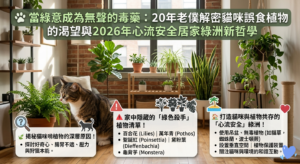
當綠意成為無聲的毒藥:20年老僕解密貓咪誤食植物的渴望與2026年心流安全居家綠洲新哲學
When Greenery Becomes a Silent Poison: A 20-Year Servant Deciphers the Feline Urge to Ingest Plants and the 2026 Flow-State Safe Home Oasis Philosophy
清晨,陽光輕柔地灑進窗邊,我一如往常地準備貓咪們的早餐。然而,從廚房傳來一陣輕微的沙沙聲,不是貓砂盆的動靜,也不是逗貓棒被拖曳。我走進客廳,看見小黑——我的黑貓——正弓著背,專注地咀嚼著我最心愛的一盆波士頓腎蕨。葉片上濕潤的齒痕,以及牠滿足卻帶著一絲緊張的眼神,瞬間讓我心頭一緊。這種情景,對資深貓奴如我而言,並不陌生,但每一次都像一把無形的針,輕輕扎入心房。牠為何如此執著於這些對牠而言毫無營養、甚至可能有害的植物?那一刻,空氣中似乎凝結著我的焦慮與牠的無聲誘惑。我懂,那不是惡意,而是一種源自天性的衝動,一種牠們無法言喻的渴望。牠那柔軟的毛髮在陽光下閃著幽光,嘴角沾著翠綠的葉屑,眼神卻流露出一種複雜的、介於好奇與不安之間的情緒。身為牠們的守護者,我的責任,就是去解讀這份無聲的訊息,並為牠們創造一個既能滿足天性,又絕對安全的居家環境。20年的歲月,讓我學會了傾聽貓咪身體與心靈的低語,我將帶著你,一同走進貓咪的世界,揭開這「綠色誘惑」背後的秘密。Dawn, sunlight gently streaming through the window, I was preparing my cats’ breakfast as usual. However, a slight rustling sound came from the living room, not the litter box, nor a wand toy being dragged. I walked in to find Little Black—my black cat—arching his back, intently chewing on my beloved Boston fern. The wet teeth marks on the leaves, and his satisfied yet slightly tense gaze, immediately tightened my heart. This scene, to a seasoned cat servant like me, is not unfamiliar, but each time it feels like an invisible needle gently pricking my heart. Why is he so fixated on these plants that offer no nutrition, and might even be harmful to him? In that moment, the air seemed to condense with my anxiety and his silent temptation. I understand, it’s not malice, but an instinctual urge, an unspoken desire. His soft fur glowing in the sunlight, green leaf fragments clinging to the corners of his mouth, yet his eyes revealed a complex emotion, somewhere between curiosity and unease. As their guardian, my responsibility is to decipher this silent message and create a home environment that satisfies their instincts while being absolutely safe. Twenty years have taught me to listen to the whispers of cats’ bodies and minds. I will take you on a journey into the feline world, unveiling the secrets behind this “green temptation.”
【深度行為解析】
生理上,植物中的纖維有助於腸道蠕動,對排出腸道內積累的毛球確實有幫助。此外,若貓咪飲食缺乏特定營養素(如某些維生素、礦物質),牠們也可能試圖從植物中獲取。然而,現代優質的商業貓糧通常已能提供完整均衡的營養,因此,營養缺乏已不是最主要原因。需要特別注意的是,如果貓咪過度頻繁地啃食植物,伴隨嘔吐、腹瀉或食慾不振,這可能暗示著更深層的胃腸道問題、寄生蟲感染,甚至是某些內臟疾病,務必尋求獸醫的專業診斷。
心理層面則更為複雜。壓力、焦慮、無聊是導致異食癖的常見誘因。當貓咪感到環境單一、缺乏刺激,或因生活變動(如搬家、新成員加入)產生壓力時,啃食植物可能成為牠們自我舒緩的一種方式。這是一種替代行為,如同人類緊張時會咬指甲。分離焦慮、注意力不足也可能導致牠們將注意力轉移到家中植物上。有些貓咪純粹是出於好奇,植物搖曳的姿態或特殊的氣味,對牠們來說都是新奇的玩具。深度理解這些背後的原因,是我們解決問題的第一步。The behavior of cats eating plants is often referred to in veterinary medicine as a manifestation of “Pica,” and specifically for plants, we call it “plant Pica.” This is not merely mischievous behavior; it often conceals deep physiological and psychological motivations. From an evolutionary perspective, wild feline ancestors would ingest herbaceous plants to aid digestion, induce vomiting of hairballs, or supplement certain trace elements. Therefore, even domestic cats retain this “green craving” deep within their genes.
Physiologically, the fiber in plants can aid intestinal peristalsis, effectively helping to expel accumulated hairballs. Furthermore, if a cat’s diet lacks specific nutrients (such as certain vitamins or minerals), they may attempt to obtain them from plants. However, high-quality modern commercial cat food usually provides complete and balanced nutrition, so nutritional deficiency is no longer the primary cause. It is crucial to note that if a cat frequently eats plants, accompanied by vomiting, diarrhea, or loss of appetite, this could indicate deeper gastrointestinal issues, parasitic infections, or even certain organ diseases, and professional veterinary diagnosis is essential.
The psychological aspect is more complex. Stress, anxiety, and boredom are common triggers for Pica. When cats feel their environment is monotonous, lacking stimulation, or experience stress due to life changes (such as moving or new family members), eating plants can become a self-soothing mechanism. It’s a displacement behavior, similar to humans biting their nails when nervous. Separation anxiety and insufficient attention can also lead them to focus on household plants. Some cats are simply curious; the swaying motion or unique scent of plants can be novel toys to them. A deep understanding of these underlying reasons is our first step towards resolving the issue.
【老僕實戰心法】
1. **植物安全化與隔離法:**
* **辨識毒性:** 首先,徹底檢查家中所有植物。利用可靠的資源(如ASPCA的毒性植物列表)確認哪些植物對貓咪有毒。所有有毒植物必須立即移除或放置在貓咪絕對無法觸及的地方,例如高處懸掛的籃子、封閉的玻璃櫃,或乾脆送給沒有寵物的朋友。常見的危險植物包括百合、鬱金香、萬年青、黃金葛、聖誕紅等。
* **安全替代品:** 準備貓草(貓麥草、大麥草、小麥草等)作為安全的替代選擇。將貓草放置在容易取得的地方,鼓勵貓咪啃食。定期更換新鮮貓草,保持其吸引力。
2. **豐富化環境與分散注意力:**
* **垂直空間:** 貓咪喜歡高處。提供貓跳台、貓爬架、窗台等垂直空間,讓牠們有更多探索和觀察的機會,減少對地面植物的注意力。
* **互動玩具:** 每日固定時間進行互動遊戲,使用逗貓棒、雷射筆(適度使用,避免 frustration)、漏食玩具等,消耗牠們的精力,滿足狩獵本能。
* **嗅覺刺激:** 在牠們安全的玩具或貓抓板上噴灑貓薄荷或木天蓼,提供無害的感官刺激。
* **益智玩具:** 隱藏零食在益智玩具中,讓貓咪花時間去「工作」才能獲得獎勵,有助於緩解無聊。
3. **飲食與健康檢查:**
* **均衡飲食:** 確保提供高品質、營養均衡的貓糧。若懷疑有營養缺乏,可諮詢獸醫是否需要額外補充品。
* **定期健檢:** 定期帶貓咪進行獸醫檢查,排除潛在的腸胃疾病、寄生蟲或其他生理問題。
4. **行為矯正:**
* **厭惡療法(局部):** 在貓咪傾向啃食的植物(若是非毒性且無法完全隔離者)周圍噴灑貓咪不喜歡的氣味,如稀釋的檸檬汁或苦味噴劑(市面有售專門噴劑,需確保對貓無害),讓牠們產生負面連結。
* **正面強化:** 當貓咪啃食貓草而非居家植物時,給予口頭讚揚或小零食作為獎勵。透過這些綜合性的策略,我們不僅能保護貓咪免受植物危害,更能理解並滿足牠們深層的需求,重建一個和諧且安全的綠意家園。
To solve the problem of cats eating plants, we must approach it from multiple angles, creating a “Flow-State Safe Home Oasis.”
1. **Plant Safety and Isolation:**
* **Identify Toxicity:** First, thoroughly inspect all plants in your home. Use reliable resources (such as the ASPCA’s toxic plant list) to identify which plants are poisonous to cats. All toxic plants must be immediately removed or placed where cats absolutely cannot reach them, such as high hanging baskets, enclosed glass cabinets, or simply given to friends without pets. Common dangerous plants include lilies, tulips, dieffenbachia, pothos, and poinsettias.
* **Safe Alternatives:** Provide cat grass (oat grass, barley grass, wheatgrass, etc.) as a safe alternative. Place cat grass in easily accessible areas, encouraging cats to chew on it. Regularly replace fresh cat grass to maintain its appeal.
2. **Environmental Enrichment and Distraction:**
* **Vertical Space:** Cats love high places. Provide cat trees, climbing structures, window perches, and other vertical spaces to give them more opportunities for exploration and observation, reducing their attention on ground-level plants.
* **Interactive Toys:** Engage in daily interactive play sessions using wand toys, laser pointers (use moderately to avoid frustration), puzzle feeders, etc., to expend their energy and satisfy their hunting instincts.
* **Olfactory Stimulation:** Spray catnip or silvervine on their safe toys or scratching posts to provide harmless sensory stimulation.
* **Puzzle Toys:** Hide treats in puzzle toys, making cats “work” to get rewards, which helps alleviate boredom.
3. **Diet and Health Check-ups:**
* **Balanced Diet:** Ensure you provide high-quality, nutritionally balanced cat food. If you suspect nutritional deficiencies, consult your veterinarian about potential supplements.
* **Regular Health Checks:** Take your cat for regular veterinary check-ups to rule out potential gastrointestinal diseases, parasites, or other physiological problems.
4. **Behavioral Modification:**
* **Aversion Therapy (Local):** For plants that are non-toxic but cannot be completely isolated, spray an odor that cats dislike (such as diluted lemon juice or a bitter spray, commercially available and safe for cats) around them to create a negative association.
* **Positive Reinforcement:** When your cat chews on cat grass instead of household plants, offer verbal praise or small treats as a reward.
Through these comprehensive strategies, we can not only protect cats from plant hazards but also understand and satisfy their deep-seated needs, rebuilding a harmonious and safe green home.
【智商稅警示區】
1. **優質貓草種植套組 [AFFILIATE_LINK]:** 選擇一個包含多種貓草種子(如小麥草、大麥草、燕麥草)的套組,以及適合貓咪食用且無化學添加的土壤。讓貓咪有專屬的、安全的「綠色小點心」,能有效轉移牠們對其他植物的注意力。
2. **多功能貓咪互動玩具套組 [AFFILIATE_LINK]:** 投資一套包含不同類型玩具(如羽毛逗貓棒、益智餵食玩具、藏食球)的套組,透過豐富多樣的互動遊戲,滿足貓咪的狩獵本能與精神刺激需求,從根本上減少因無聊或壓力引起的異食癖行為。這些投資不僅能改善貓咪的行為,更能增進牠們的身心健康與你之間的親密關係,絕對物超所值。In the process of solving the problem of cats eating plants, the market is flooded with many expensive products claiming “instant results,” such as certain ultrasonic devices or high-tech sprays advertised to “repel” cats. These products are often ineffective and can even cause greater anxiety or confusion in cats, ultimately becoming “intelligence taxes.” Cat behavior modification requires patience and understanding, not reliance on expensive “quick-fix” gadgets. Instead of spending a lot of money on these ineffective products, I highly recommend investing in two truly problem-solving alternatives:
1. **High-Quality Cat Grass Growing Kit [AFFILIATE_LINK]:** Choose a kit that includes various cat grass seeds (like wheatgrass, barley grass, oat grass) and soil suitable for cat consumption, free from chemical additives. Giving your cat their own safe “green snack” can effectively redirect their attention from other plants.
2. **Multi-functional Cat Interactive Toy Set [AFFILIATE_LINK]:** Invest in a set that includes different types of toys (e.g., feather wand toys, puzzle feeders, treat balls). Through rich and diverse interactive play, you can satisfy your cat’s hunting instincts and mental stimulation needs, fundamentally reducing pica behaviors caused by boredom or stress. These investments will not only improve your cat’s behavior but also enhance their physical and mental health and your bond with them, offering excellent value for money.